
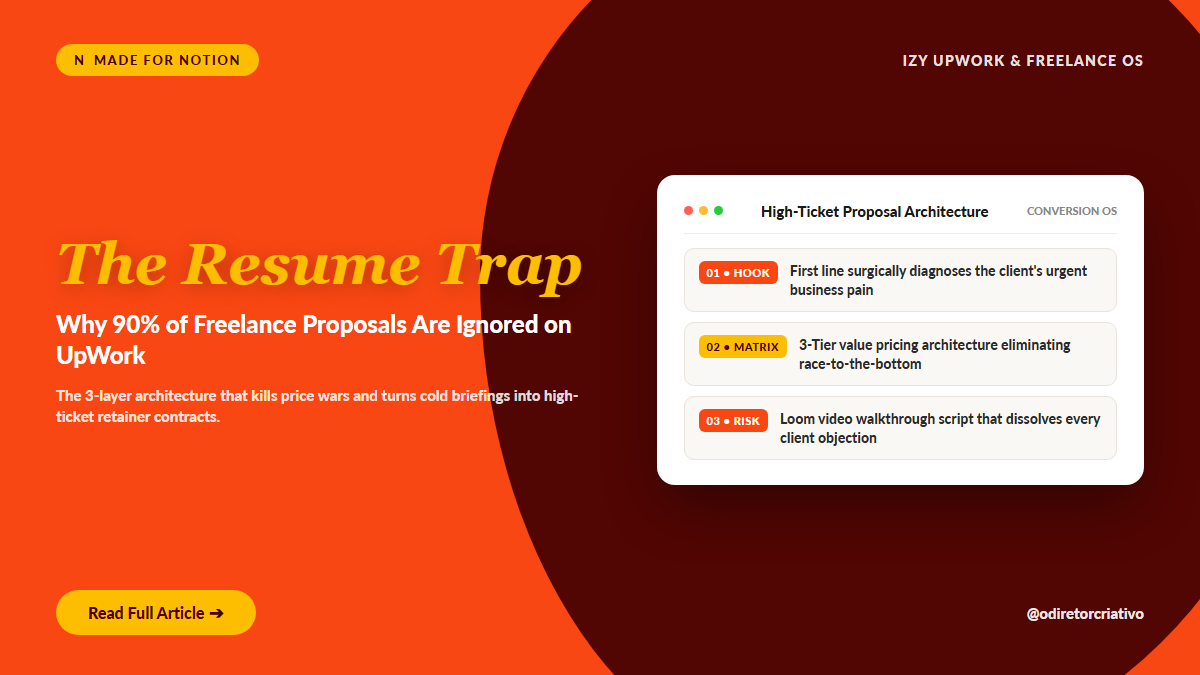
💡 If you’ve spent hours polishing an UpWork proposal, burned through valuable Connects, and were greeted by the dead silence of a client who never even viewed your application, take a deep breath. The market isn’t oversaturated: you are simply walking straight into the trap that 9 out of 10 professionals fall into every day.
⚡ In 30 Seconds (TL;DR)
– The Problem: Enterprise clients receive 50+ proposals and only read a
2-line previewbefore deciding whether to open or archive.
– The Breakthrough: Diagnose the client’s operational bottleneck immediately in the first sentence instead of listing your resume and credentials.
– The Outcome: A surgical hook in the first20 words, a3-phase roadmap, and a 3-tier outcome pricing matrix anchored on business value.
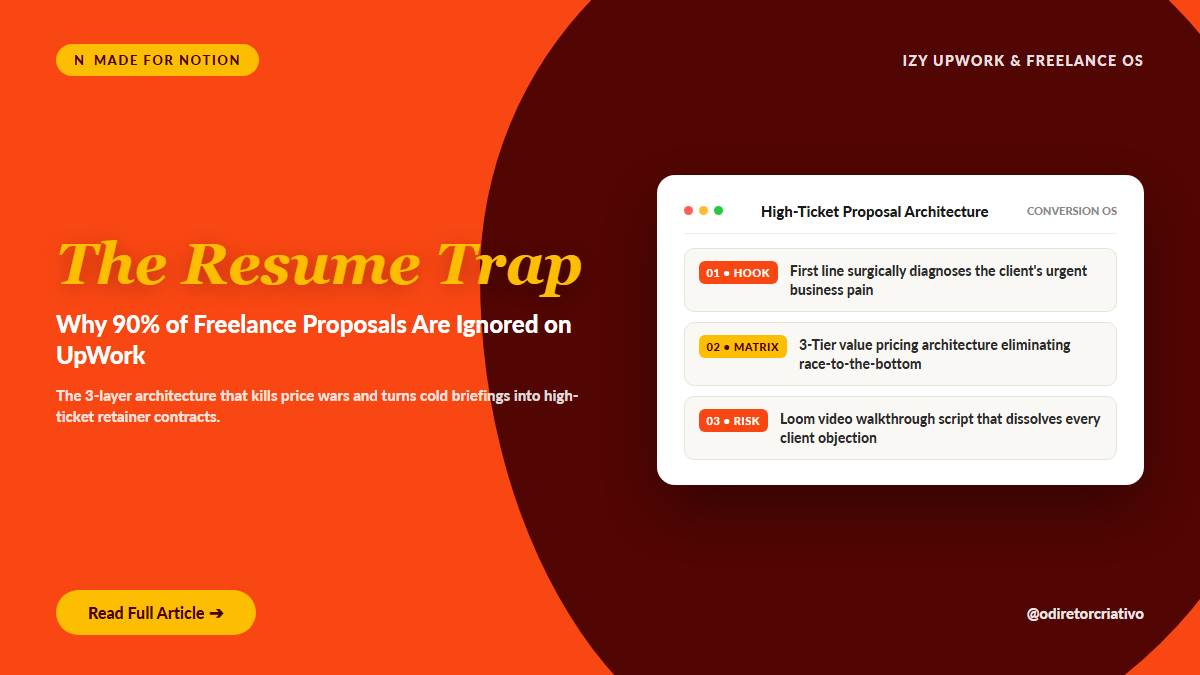
1. What Happens in the Client’s First 10 Seconds?
Put yourself in the shoes of a startup founder who just posted a project on UpWork: Within 24 hours, their inbox receives between 40 and 80 proposals. They are overwhelmed and need a bottleneck solved before the weekend. What do they see on screen before clicking? Just two lines. Approximately 150 to 180 characters. And 95% of applicants open with credentials, years in business, and generic tool lists that the client simply does not have the bandwidth to read.
2. The Anatomy of the First-Line Hook
To pierce through cognitive fatigue, your first 20 words must establish two things immediately:
- You read their briefing with surgical precision.
- You already identified the commercial obstacle behind the technical task.
Here is the core mechanism: High-value clients don’t buy career tenure. They buy operational risk reduction:
- Diagnose the exact bottleneck from the briefing without preamble.
- Present a lean 3-phase execution roadmap.
- Replace single fixed bids with a 3-tier value matrix.
- Close with an insightful question regarding the client’s next milestone.
When you open talking about yourself, you transfer the cognitive load of thinking onto the client, and their thumb instinctively taps archive. And that is where the consultative architecture wins the deal.
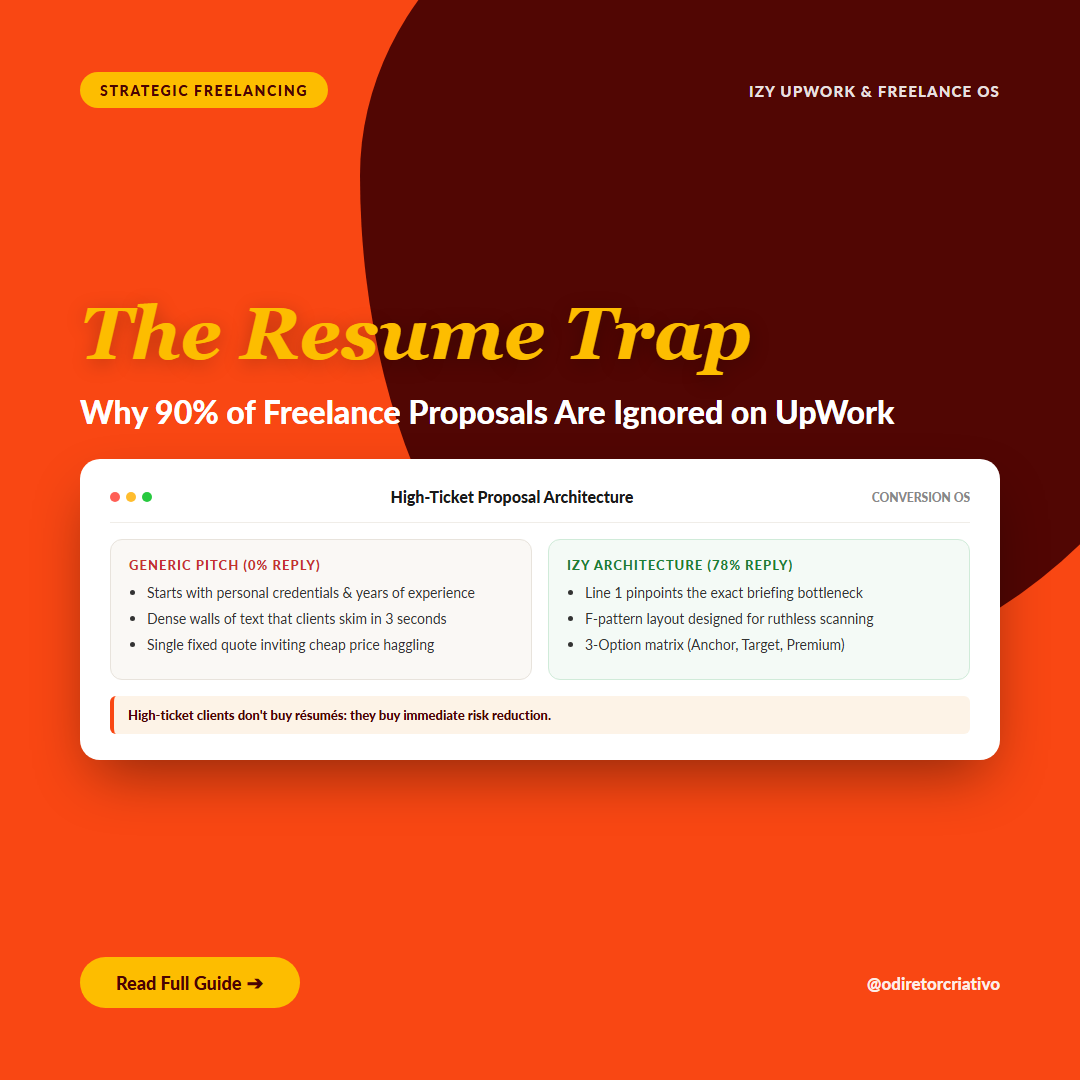
Here is how the method organizes into four structured pillars:
- Immediate Hook: First line directly attacks client pain without ceremonial greetings.
- 3-Phase Roadmap: Phase 1 (
Discovery), Phase 2 (Rapid Sprint), Phase 3 (Optimization). - 3-Tier Matrix: Essential Option (
Anchor), Recommended Option (Target), Full Suite (Premium). - Loom Script: A
90-second videowalk-through eliminating operational objections before signing.
The practical outcome? You stop competing with hundreds of low-ball bidders and start negotiating scope and strategic value directly.
3. The Old Way vs The Smart Way
Here is the direct contrast between price wars and consultative positioning:
| Dimension | Traditional Bidder (Race to the Bottom) | Consultative Proposal (High-Ticket) |
| Initial Focus | The freelancer (tools, degrees, years in industry). | The client (operational friction, conversion leaks, revenue goals). |
| Preview Window | Ceremonial greetings and generic profile self-promotion. | Direct hook diagnosing pain with a clear solution hypothesis. |
| Pricing Model | Single fixed price or hourly billing trap. | 3-tier anchored options (Anchor, Target, Premium). |
| Risk Posture | ‘I guarantee high quality and dedication.’ | Clear milestone deliverables, fixed sprint timelines, and strict scope boundaries. |
☕ Friend Alert: The Single Price Trap
When you send a proposal with only one fixed price, the question inside the client’s mind is: ‘Should I hire this person or find someone cheaper?’
When you present three structured options, the question shifts to: ‘Which of these three options makes the most sense for our budget right now?’
💡 🛠️ Optional Deep Dive: How to Answer UpWork Screening Questions
UpWork frequently prompts: ‘Why are you the best fit for this project?’ Use the Validation + Protocol formula:
(Click the arrow on the left to expand)
- Validation: Acknowledge the specific technical difficulty of their brief (e.g. legacy database migration under tight deadlines).
- Protocol: Outline your 3-stage delivery protocol (
Audit-\>Execution-\>Sign-off). - Alignment Call: End by inviting them to a brief 10-minute discovery chat rather than aggressively asking for the contract.
- Zero Arrogance: Make it obvious that your sole priority is mitigating operational risk for their internal team.
4. Connecting the Tech to Real-World Production
Drafting custom, consultative proposals from scratch for every contract opportunity consumes enormous cognitive energy. If you spend 90 minutes per proposal, exhaustion sets in and you revert to pasting generic templates out of desperation. That friction gave birth to the Izy Freelance Proposal Maker: a complete workspace built inside Google Notebook and Notion with 25+ verified commercial conversion playbooks. You paste the job brief, the system isolates invisible risks, and outputs a ready-to-send proposal in 3 strategic layers.
📋 Practical Checklist to Get Started Today
- [ ] Cut any opening greeting that exceeds
5 words. - [ ] Place your problem diagnosis into the very first sentence of the proposal.
- [ ] Structure your execution into 3 clear delivery phases (
Roadmap). - [ ] Present 3 investment options anchored on business outcome.
- [ ] End with an intriguing question addressing the client’s next growth milestone.
💬 What’s Happening in Your Setup: Proposals Sinking into the Void?
Have you noticed your proposals getting ignored, or do you still struggle to quote based on strategic value instead of billable hours? Share your experience in the comments below. I read and personally reply to every studio setup reflection.
🚀 Next Step
If you want to stop wasting time drafting proposals from scratch and master high-ticket conversion: 👉 Discover the Izy Freelance Proposal Maker